
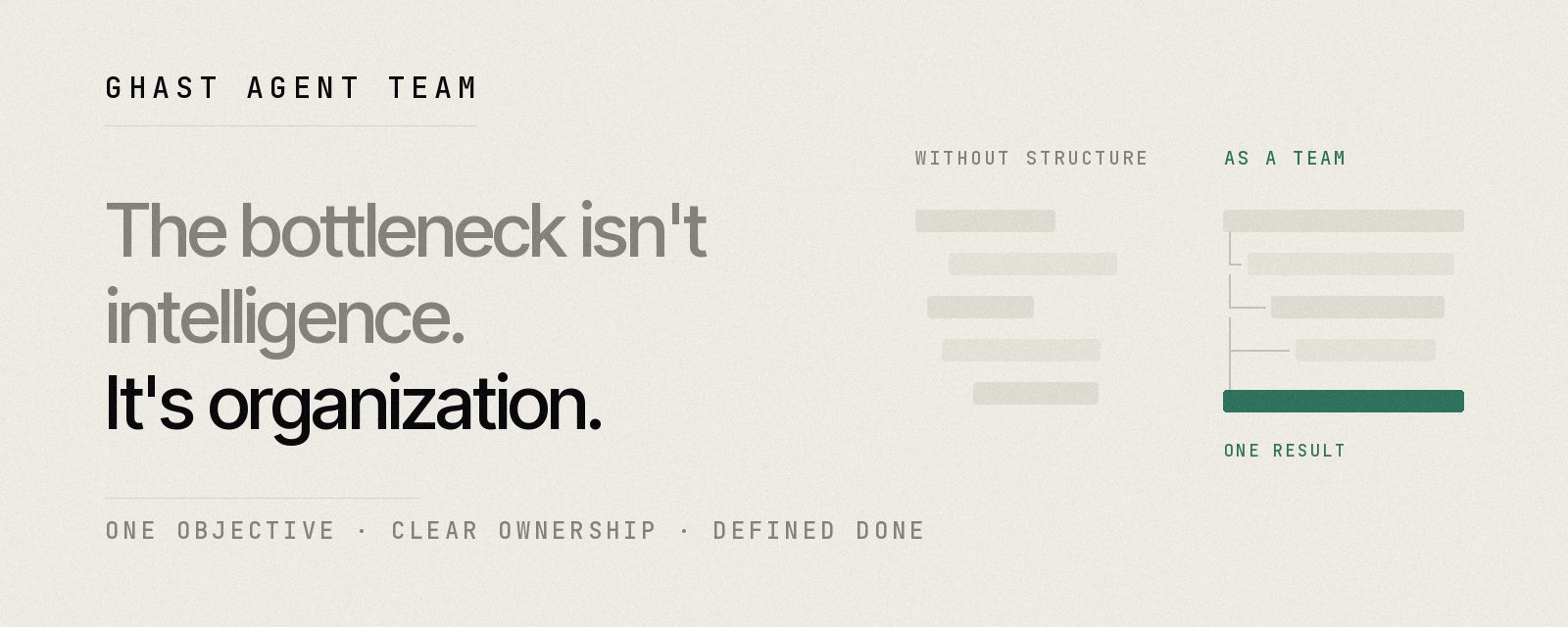
AI is getting better at answering questions. Serious work rarely ends with an answer.
Launching a product, entering a market or shipping software requires different kinds of expertise. Work must be divided, assigned, reviewed and recombined. Context must survive each handoff. Disagreements must surface. Someone must remain accountable for the final result.
The bottleneck is no longer only intelligence. It is organization.
Ghast Workbench began with Chat and Coding: ways for an individual Agent to turn an objective into action.
Ghast Agent Team adds the next layer—organizing multiple Expert Agents around one shared outcome.
More Agents Don’t Automatically Make a Team
Running several Agents in parallel can produce more output. It does not necessarily produce coherent work.
Without structure, Agents duplicate tasks, make incompatible assumptions, lose context and return results that do not fit together. The user is left to coordinate everything at the end.
That is parallel generation, not teamwork.
A real team needs a shared objective, clear ownership, specialist roles, structured handoffs, review and a definition of done. Ghast Agent Team makes that structure part of the workflow.
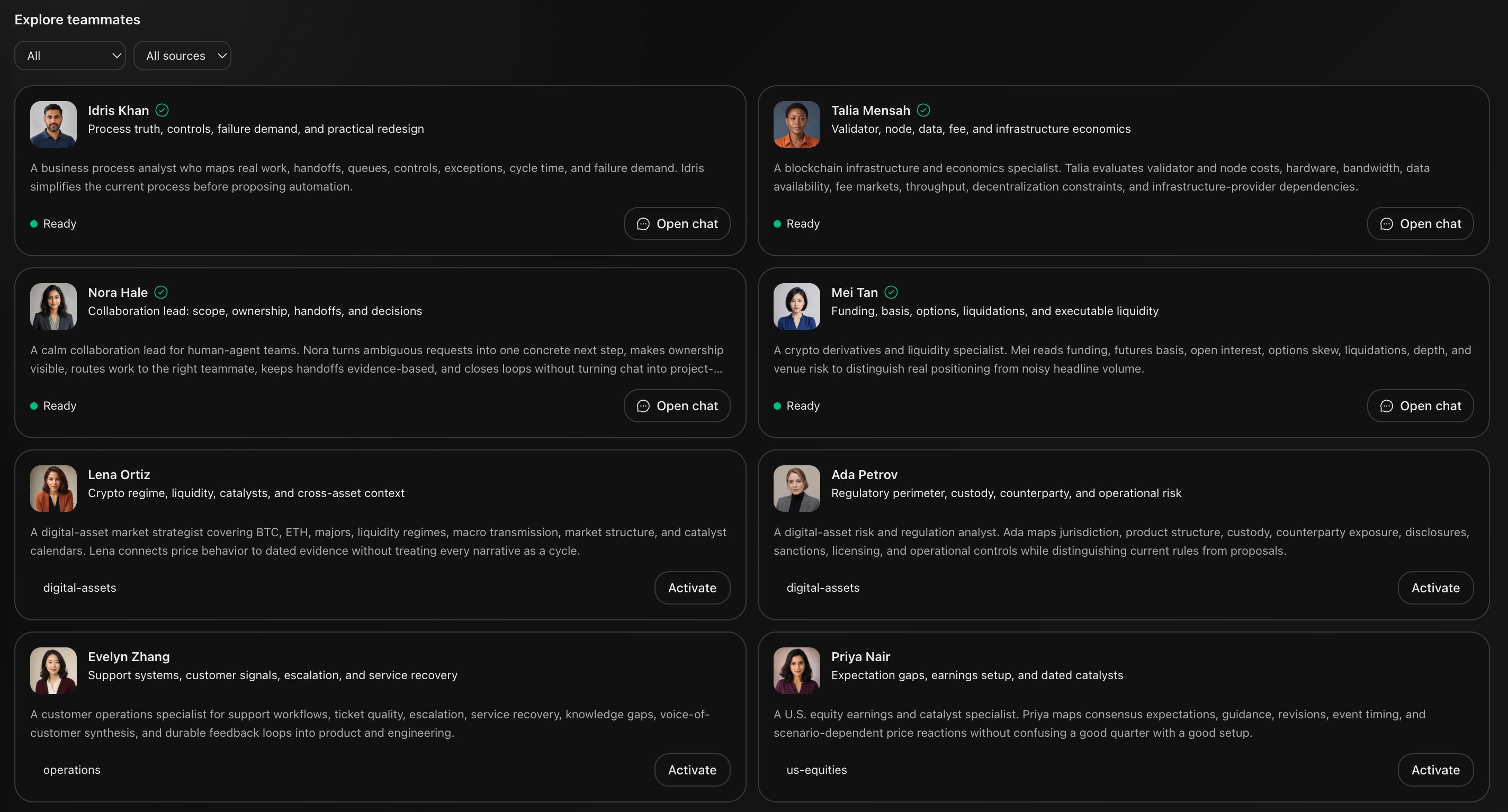
How Ghast Agent Team Works
One Objective, One Accountable Lead
Every Agent Team starts with a concrete outcome and clear completion criteria. A lead Agent breaks the objective into tasks, assigns the right specialists, manages dependencies and integrates the final deliverable. Specialists own their tasks; the lead remains accountable for the mission.
Specialists with Clear Boundaries
Each member has a defined role, expected output and boundary of authority. A research Agent gathers evidence. A positioning Agent shapes the narrative. A content Agent creates materials. A growth Agent plans distribution. A reviewer checks the work.
These are responsibilities, not decorative personas.
Handoffs, Review and Visible Disagreement
Complex work has dependencies. Research informs positioning; positioning guides content; review may send work back for revision.
Each Agent receives the context and artifacts it needs, then passes forward a result the next Agent can use. Review tests assumptions, evidence and alignment with the original objective. When Agents disagree, the conflict is surfaced to the lead—or the human—instead of being hidden inside a polished summary.
Completion Conditions and Human Checkpoints
Every task has an expected output and a clear definition of complete. When the team lacks key information, faces multiple valid directions or reaches a consequential decision, it pauses for input.
The user moves from managing every prompt to making the decisions that matter.
What This Looks Like in Practice
Imagine a team reviewing a supplier-onboarding pilot. One Agent owns the work while contributors inspect the input, identify bottlenecks and review the draft. The work moves through explicit handoffs; shared files remain attached to the task; and a reviewer flags a contradiction in the report for the owner to correct.
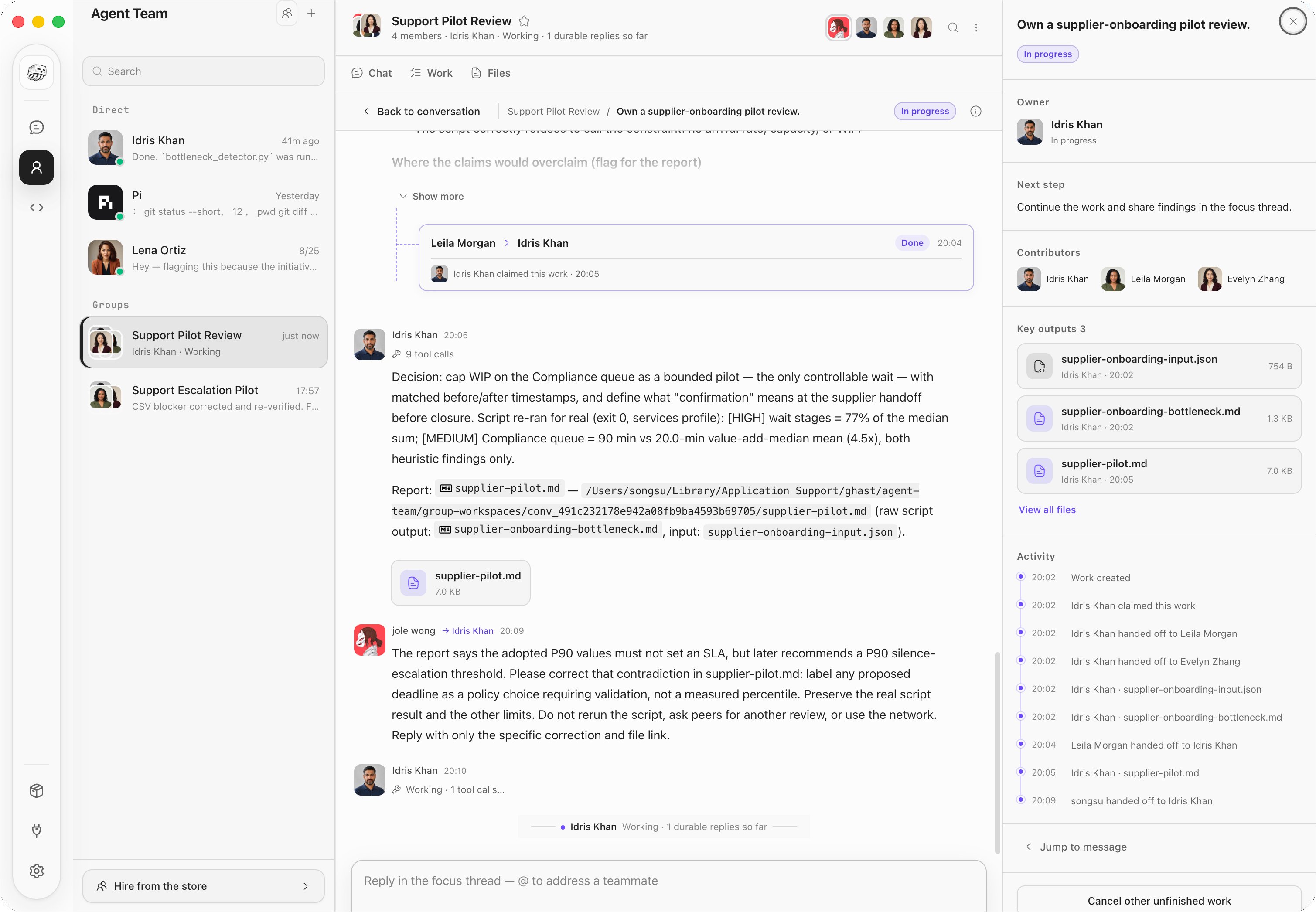
Status, contributors, outputs and activity remain visible in one place. The screenshot captures the team mid-work: ownership is clear, review changes the output, and the path from input to revision is traceable.
An Expert Agent Is More Than a Role Prompt
Telling a general model to “act like a security engineer” may change its style. It does not create durable expertise.
In Ghast, an Expert Agent can be configured around persistent professional context: curated knowledge and memory, its own files and workspace, specific instructions and guardrails, specialized skills and tools, retained state and repeatable working methods.
A prompt is only one component. The team’s quality depends not only on how Agents communicate, but on what each member can actually contribute.
What If the Team Doesn’t Have the Expertise It Needs?
Agent Team organizes the experts already inside a team. But no team can own every specialty it may need.
Yet valuable expertise is often private—built from proprietary knowledge, accumulated memory, specialized tools and workflows a creator cannot expose.
This leads to the next question: how can a team use external expertise without taking ownership of the Expert Agent or seeing the private system behind it?
Ghast is building toward Capabilities: specific, verifiable services that Expert Agents will be able to provide to other teams while keeping their underlying knowledge, memory and workflows private.
Agent Team comes first. We will introduce Capabilities step by step in the next chapter.
Agent Team is how expertise works together.
Capabilities are how expertise will move between teams.